
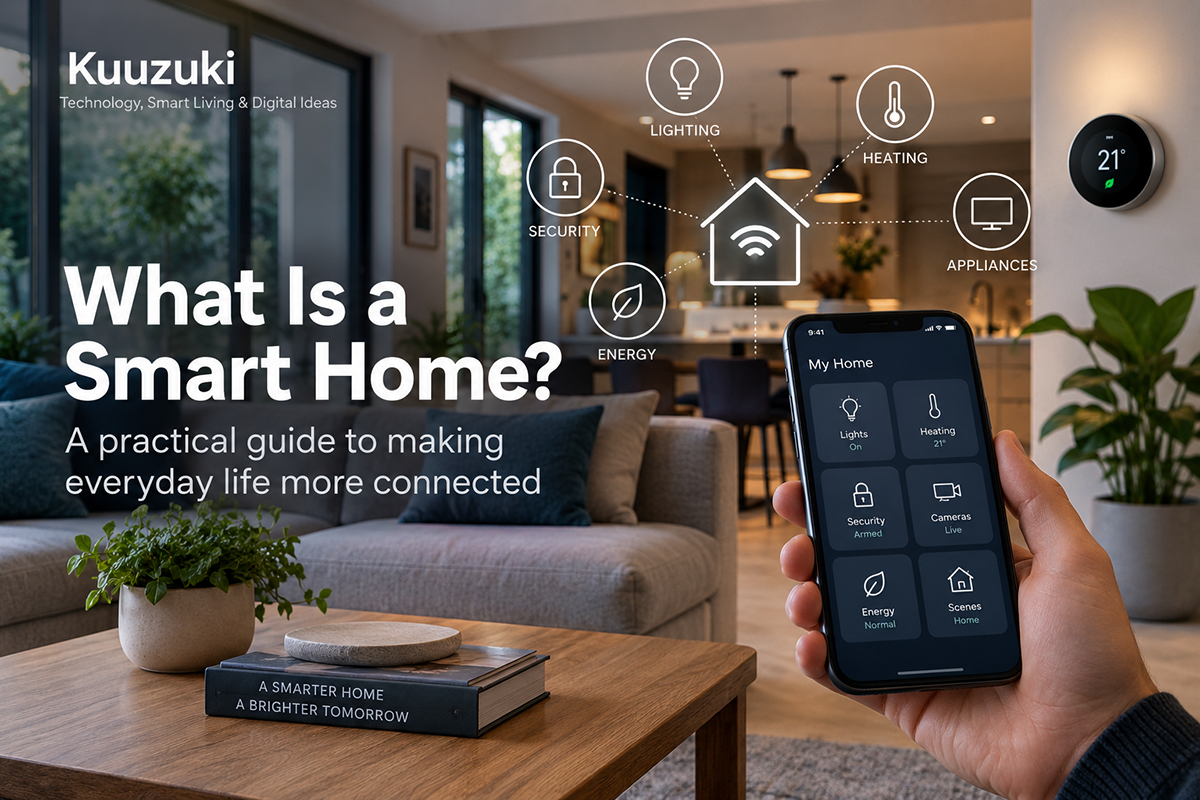
Smart-home technology has moved far beyond novelty gadgets and voice-controlled lights. Today, it can be used to improve comfort, security, energy efficiency and everyday convenience without turning a home into something that feels overly complicated.
A smart home is simply a property where connected devices can communicate with each other, respond to instructions and, in some cases, automate routine tasks. That can mean anything from a thermostat that adjusts the heating automatically to security cameras that send alerts to your phone.
The most useful smart homes are not necessarily the ones with the largest number of devices. They are the ones where technology solves practical problems without becoming difficult to manage.
What Makes a Home “Smart”?
A smart home usually includes devices connected through Wi-Fi, Bluetooth, Zigbee, Thread or another wireless standard.
These devices can often be controlled using:
- a smartphone app
- a smart speaker
- a central hub
- automated schedules
- motion or environmental sensors
- voice assistants
- predefined routines
A single smart bulb technically counts as smart-home technology, but the concept becomes more useful when several devices work together.
For example, a motion sensor in a hallway could turn on the lights after sunset. A smart thermostat could reduce the heating when nobody is home. A doorbell camera could send an alert when someone approaches the front door.
The technology becomes valuable when it removes small repetitive tasks from everyday life.
Smart Lighting
Lighting is one of the easiest ways to start building a smart home.
Smart bulbs, switches and lighting systems allow users to control brightness, colour temperature and schedules from a phone or voice assistant.
More advanced systems can adjust lighting automatically depending on the time of day.
Bright, cooler lighting might be useful during the morning, while warmer lighting can create a more relaxed atmosphere in the evening.
Smart lighting can also be useful when nobody is home. Scheduled or remotely controlled lights can make a property appear occupied while residents are away.
For many households, smart lighting is a sensible first step because it is relatively inexpensive and does not normally require major changes to the property.
Smart Heating and Energy Management
Heating is another area where connected technology can provide practical benefits.
Traditional thermostats rely largely on fixed schedules. Smart thermostats can offer more flexibility by learning household routines or allowing users to control heating remotely.
Some systems can detect when occupants leave the property and reduce heating automatically.
Others allow individual rooms to be controlled separately using smart radiator valves.
This can be particularly useful in larger homes where certain rooms are only used occasionally.
Smart plugs and energy monitors can also provide information about electricity consumption. Instead of guessing which appliances are using the most power, homeowners can see actual usage data and adjust their habits accordingly.
The biggest benefit is not necessarily dramatic automation. Often it is simply having better information and more precise control.
Smart Home Security
Security technology has become one of the fastest-growing areas of the smart-home market.
Common devices include:
- video doorbells
- outdoor cameras
- indoor cameras
- smart locks
- door and window sensors
- motion detectors
- connected alarm systems
Many modern systems send notifications directly to a smartphone when unusual activity is detected.
Video doorbells are particularly popular because they allow homeowners to see and communicate with visitors even when they are away from home.
Smart locks can also provide temporary access codes for visitors, cleaners or tradespeople without requiring a physical key to be handed over.
However, smart security devices should always be configured carefully. Strong passwords, two-factor authentication and regular software updates are important because internet-connected devices can introduce new security risks as well as solve old ones.
Smart Kitchens
Kitchen technology is gradually becoming more connected.
Smart appliances can include ovens, refrigerators, coffee machines, dishwashers and even extractor fans.
Some connected ovens allow users to monitor cooking progress remotely, while smart refrigerators may provide temperature alerts or help track food storage.
However, expensive smart appliances are not always necessary.
Simple additions such as smart plugs, connected lighting and voice assistants can provide many of the same everyday convenience benefits for a much lower cost.
The key question should always be whether the technology improves how the kitchen is actually used.
A connected feature that looks impressive but rarely saves time or effort may not justify the extra cost.
Smart Bathrooms
Bathrooms are also beginning to incorporate more technology.
Examples include:
- smart mirrors
- digital showers
- automated lighting
- humidity sensors
- heated mirrors
- smart ventilation
- leak detectors
Humidity sensors can be particularly practical because they can activate ventilation automatically when moisture levels rise.
Water-leak sensors are another relatively inexpensive addition that can provide early warning of plumbing problems.
Placed near toilets, baths, washing machines or under sinks, they can send an alert when water is detected.
This type of technology is less glamorous than a voice-controlled mirror, but it may provide far more practical value.
Smart Speakers and Voice Assistants
Smart speakers often act as the easiest way to control multiple connected devices.
Users can ask a voice assistant to turn off lights, adjust heating, play music, set timers or activate predefined routines.
A routine could, for example, turn off downstairs lights, reduce the heating and lock compatible doors when someone says “good night”.
However, voice control should usually complement rather than replace traditional controls.
A light switch should still work when a phone battery is flat or an internet connection temporarily fails.
Good smart-home design keeps essential functions simple and accessible.
Automation Is More Important Than Remote Control
One common misunderstanding about smart homes is that their main purpose is allowing people to control things from a phone.
Remote control can certainly be useful, but automation is often more valuable.
A truly useful smart system should require less interaction over time.
Examples might include:
- lights switching on automatically when someone enters a dark hallway
- heating lowering when the property becomes empty
- blinds closing automatically after sunset
- outdoor lights activating when movement is detected
- bathroom ventilation responding to humidity
- appliances switching off during certain hours
The goal is not to spend more time controlling the home through an app.
Ideally, the technology should quietly manage routine tasks in the background.
Do You Need a Smart Home Hub?
Some smart devices connect directly to Wi-Fi and can be controlled independently through their own apps.
Others work through dedicated hubs.
A hub can make larger smart-home systems easier to manage because multiple devices can communicate through one central platform.
Whether one is necessary depends on how complex the setup becomes.
For someone with two smart bulbs and a thermostat, a hub may provide little benefit.
For a household with dozens of sensors, lights, switches and security devices, centralised control can become much more useful.
Compatibility is important before buying equipment. Not every smart-home product works with every platform.
Standards such as Matter are intended to make different ecosystems work together more easily, but checking compatibility before purchasing remains sensible.
Privacy and Security Should Not Be Ignored
Adding connected devices to a home also creates more points of connection to the internet.
That means security needs to be taken seriously.
Basic precautions include using unique passwords, enabling two-factor authentication where available and keeping device software updated.
It is also worth considering how much information each device actually needs.
A light bulb does not necessarily need access to every permission on a smartphone.
Consumers should also understand where recordings and other data are stored, particularly when using cameras, microphones or voice assistants.
Convenience is useful, but it should not come at the expense of basic digital security.
Start Small
The easiest mistake when building a smart home is trying to automate everything immediately.
A better approach is to identify one or two everyday problems first.
Perhaps a hallway is always dark when someone arrives home.
Maybe heating is regularly left running in empty rooms.
Perhaps deliveries are frequently missed.
Solving those individual problems with smart lighting, heating controls or a video doorbell creates immediate value.
Once those systems prove useful, additional devices can be added gradually.
This approach also makes it easier to choose compatible products and avoid spending money on technology that eventually goes unused.
A Smarter Home Should Still Feel Simple
Smart-home technology works best when it disappears into everyday life.
The objective should not be to fill a property with gadgets simply because they can connect to the internet.
Good technology should make ordinary tasks easier, improve awareness of what is happening around the property and reduce unnecessary energy use.
For some households that might involve dozens of connected devices.
For others, a smart thermostat, a few lights and a video doorbell may be enough.
There is no single definition of the perfect smart home.
The best setup is simply the one that quietly makes the home easier to live in.