
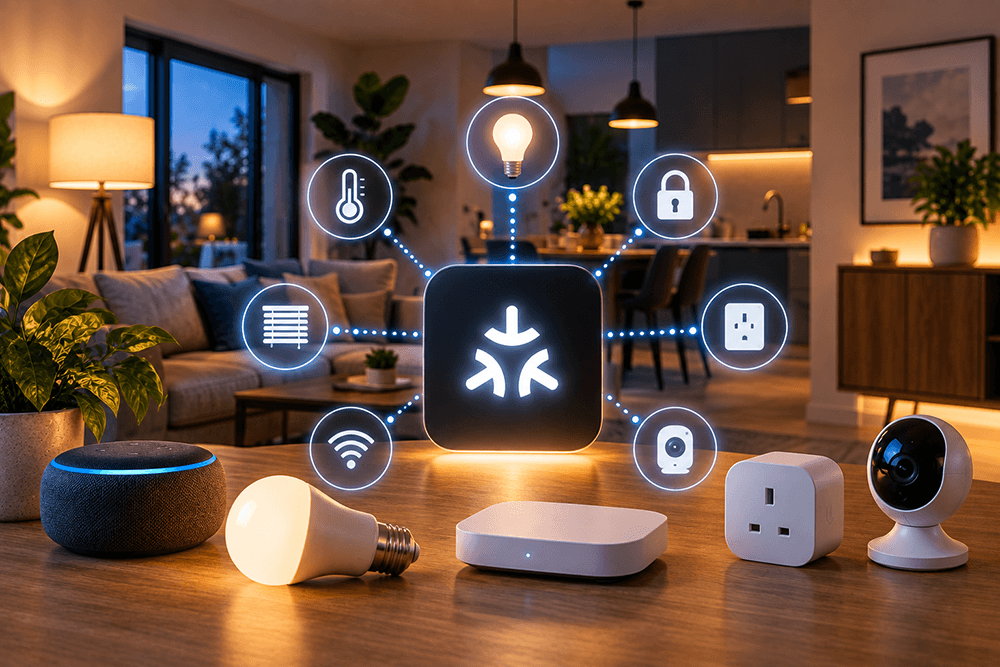
Smart-home technology has become much easier to use over the last few years, but compatibility has remained one of its biggest frustrations.
A smart bulb might work perfectly with one platform but not another. A thermostat may require its own app. A sensor bought for one ecosystem may not communicate with devices from a different manufacturer.
Matter was created to make this situation simpler.
It is a smart-home connectivity standard designed to help devices from different brands work together more reliably. Instead of each manufacturer building a completely separate ecosystem, Matter provides a common language that compatible devices can use.
For everyday users, the goal is straightforward: buying and connecting smart-home products should become less confusing.
What Is Matter?
Matter is an industry-backed standard for connected devices.
It was developed by the Connectivity Standards Alliance, with support from major technology companies including Apple, Google, Amazon and Samsung.
The idea is to create a shared framework so that compatible devices can work across multiple smart-home platforms.
A Matter-compatible device may therefore be able to connect to more than one ecosystem without requiring a completely different version of the product.
This can make it easier for households to mix devices from different manufacturers.
Why Was Matter Needed?
Smart-home technology developed quickly, but different companies often created their own closed systems.
This resulted in several problems.
Consumers frequently had to check whether a device worked with:
- Apple Home
- Google Home
- Amazon Alexa
- Samsung SmartThings
- another manufacturer-specific platform
Even when products performed similar functions, they were not always able to communicate with each other.
This fragmentation made smart-home systems harder to build and maintain.
Matter aims to reduce that complexity by giving manufacturers a common technical foundation.
Does Matter Replace Wi-Fi?
No.
Matter is not a replacement for Wi-Fi or other networking technologies.
Instead, it operates on top of existing connection methods.
Matter devices commonly use:
- Wi-Fi
- Ethernet
- Thread
Bluetooth may also be used during the initial setup process.
The important point is that Matter defines how compatible smart-home devices communicate rather than replacing the network itself.
What Is Thread?
Thread is another technology that is frequently mentioned alongside Matter.
It is a low-power wireless networking protocol designed specifically for connected devices.
Unlike traditional Wi-Fi, Thread is particularly well suited to small devices such as:
- sensors
- switches
- smart locks
- thermostats
- lighting controls
Thread devices can form a mesh network.
This means devices can help pass information between each other rather than every device needing a direct connection to the router.
The result can be a more resilient network, particularly in larger homes.
Matter and Thread are separate technologies, but they are often used together.
What Is a Thread Border Router?
A Thread border router connects a Thread network to the rest of the home network.
It acts as a bridge between Thread devices and technologies such as Wi-Fi or Ethernet.
Some smart-home hubs, speakers and displays already include Thread border-router functionality.
This means users may already own compatible hardware without realising it.
The exact hardware required depends on the smart-home platform and devices being used.
What Devices Support Matter?
Matter support has gradually expanded across several smart-home categories.
Compatible products can include:
- smart bulbs
- smart plugs
- switches
- thermostats
- door locks
- blinds
- sensors
- hubs
- smart speakers
- televisions
- home appliances
Support varies between manufacturers and product generations, so the presence of a Matter logo does not necessarily mean every advanced feature will work identically across every platform.
However, basic functions should be easier to share between ecosystems.
Does Matter Mean Every Device Works With Everything?
Not quite.
Matter improves compatibility, but it does not eliminate every difference between smart-home platforms.
A device may support standard functions through Matter while still offering additional features through the manufacturer’s own app.
For example, a smart light may allow basic control such as:
- on and off
- brightness adjustment
- colour control
through Matter.
More advanced effects, firmware settings or automation options might still require the manufacturer’s app.
Matter therefore provides a common baseline rather than making every smart-home ecosystem identical.
Local Control Is an Important Advantage
One of the most useful aspects of Matter is its emphasis on local communication.
Many older smart-home systems depend heavily on cloud servers.
A command may travel from a smartphone to an external server and then return to the device inside the home.
Matter allows many commands to be handled locally instead.
This can improve:
- response times
- reliability
- privacy
- resilience during internet outages
A smart-home device should ideally continue performing essential functions even if an external service becomes temporarily unavailable.
Local communication helps make that possible.
Multi-Admin Support
Matter also supports something called multi-admin.
This allows the same compatible device to be controlled by more than one smart-home platform.
For example, one household member might prefer Apple Home while another uses Google Home.
A compatible Matter device may be added to both ecosystems rather than forcing the entire household to use one platform.
This is particularly useful in homes where different people use different phones, speakers or assistants.
Does Matter Improve Privacy?
Matter can reduce the need for some cloud-based communication, but it should not be considered a complete privacy solution.
Devices may still collect data depending on how the manufacturer designs its services.
Users should still check:
- privacy policies
- account requirements
- cloud features
- microphone or camera permissions
- data-sharing settings
Local control can reduce unnecessary internet communication, but privacy still depends on the individual product and platform.
Is Matter More Secure?
Security has been built into the standard from the beginning.
Matter uses encryption and device authentication to help prevent unauthorised devices from joining a smart-home network.
Certified devices are also required to prove their identity during setup.
However, users still need to follow basic security practices.
That includes:
- keeping devices updated
- using strong passwords
- securing the home Wi-Fi network
- enabling two-factor authentication where available
No connectivity standard removes the need for sensible digital-security habits.
Do You Need to Replace Existing Smart-Home Devices?
Probably not.
Existing smart devices do not suddenly become obsolete because they lack Matter support.
If the current system works reliably, replacing functioning equipment simply to gain Matter compatibility may provide little benefit.
Some manufacturers have also added Matter support to existing products through software updates or hubs.
The practical approach is usually to consider Matter when buying new equipment rather than replacing everything immediately.
Over time, a household can gradually move towards a more interoperable system.
What Should You Look for When Buying New Devices?
Before buying a new smart-home device, check whether it supports Matter and which connectivity technology it uses.
You should also check whether your existing smart-home platform can control the device.
Matter simplifies compatibility, but planning is still useful.
A good purchase should answer three questions:
- Does it solve a genuine problem?
- Does it work with the platform already used in the home?
- Will it remain useful if the household changes platforms later?
Matter can help considerably with the third question.
Matter Does Not Automatically Make a Product Good
Compatibility is only one part of choosing smart-home equipment.
A poorly designed device does not become a good product simply because it supports Matter.
Build quality, reliability, software support and usability still matter.
Consumers should also consider whether manufacturers provide regular security updates.
The Matter logo can make compatibility easier to understand, but it should not replace normal product research.
Should You Choose Matter Devices Today?
For someone starting a new smart-home system, Matter support is worth considering.
It can provide greater flexibility and reduce the chance of becoming locked into one ecosystem.
For existing smart homes, there is usually no urgency to replace devices that already work well.
The most sensible approach is gradual.
When an existing device needs replacing or a new feature is added, choosing Matter-compatible products can help create a more flexible system over time.
A More Connected Future
Matter does not solve every smart-home problem.
Different manufacturers will continue to offer different features, apps and services.
However, it addresses one of the industry’s longest-running frustrations: devices that cannot easily work together.
For everyday users, that could eventually mean fewer compatibility checks, fewer unnecessary hubs and a simpler setup process.
The most successful smart-home technology is usually the technology that requires the least effort to use.
If Matter continues to gain support across the industry, it could help move connected homes closer to that goal.