
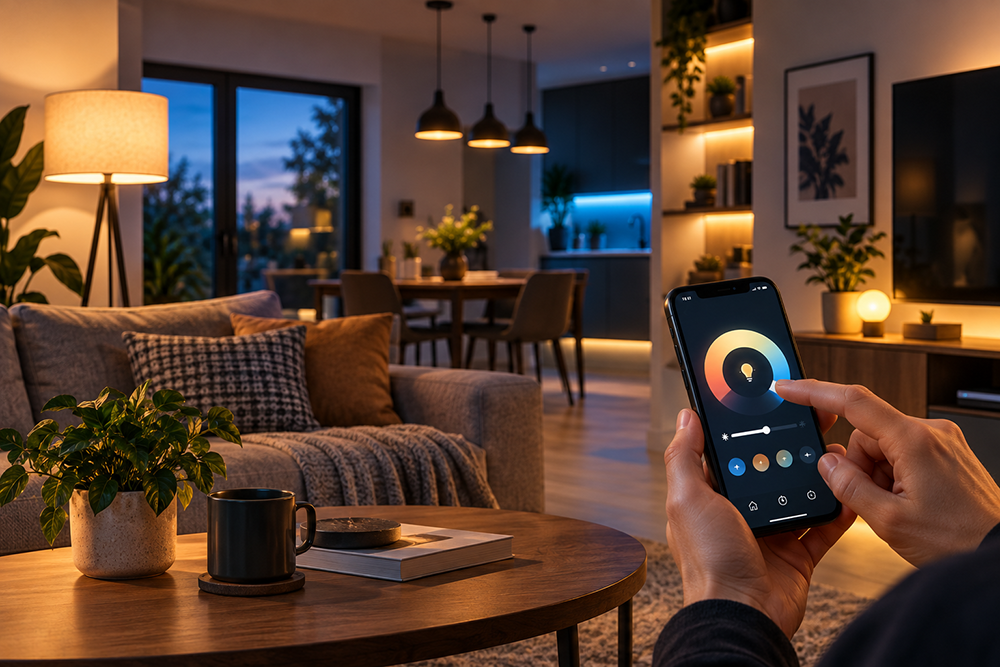
Smart lighting is often one of the first technologies people introduce when building a connected home.
It is relatively easy to install, does not normally require major renovation work and can provide benefits almost immediately. Lights can be controlled remotely, scheduled automatically and adjusted according to the time of day, activity or occupancy of a room.
However, smart lighting involves more than simply replacing traditional bulbs with Wi-Fi-enabled alternatives.
A well-planned system should remain simple to use while providing useful automation in the background.
What Is Smart Lighting?
Smart lighting refers to lights, bulbs, switches or controllers that can be managed digitally rather than relying only on a traditional wall switch.
Depending on the system, users may be able to control lighting through:
- a smartphone app
- voice assistants
- wireless switches
- motion sensors
- schedules
- smart-home routines
- presence sensors
- central home-automation platforms
Some products connect directly to a home Wi-Fi network, while others use technologies such as Zigbee, Thread or Bluetooth.
The main difference from traditional lighting is that smart lights can respond automatically to conditions rather than requiring someone to operate a switch every time.
Smart Bulbs or Smart Switches?
One of the first decisions is whether to use smart bulbs or smart switches.
Both approaches can work well, but they solve slightly different problems.
Smart bulbs
Smart bulbs contain their own wireless electronics.
They are normally installed in the same way as standard bulbs and can then be configured using an app.
Depending on the model, they may offer:
- dimming
- colour-temperature adjustment
- coloured lighting
- schedules
- remote control
- voice control
Their biggest advantage is simplicity.
Someone can experiment with smart lighting by replacing only one or two bulbs without changing the electrical installation.
The disadvantage is that the existing wall switch generally needs to remain switched on for the smart functions to work.
If someone turns the physical switch off, the bulb may become unavailable to the smart-home system.
Smart switches
Smart switches replace or complement traditional wall switches.
Instead of making each individual bulb smart, the switch controls the entire lighting circuit.
This can be a more natural solution because the lights continue to behave like ordinary household lighting.
People can still walk into a room and press the wall switch without thinking about an app.
Smart switches can also be useful where a fitting contains several bulbs.
However, installation can be more complicated and electrical work may be required depending on the system and existing wiring.
Dimming Without Changing the Atmosphere
One of the simplest benefits of smart lighting is better control over brightness.
A room may need bright lighting during cleaning or working but softer lighting in the evening.
Instead of using several different lamps or manually adjusting dimmers, smart systems can store preferred brightness settings.
For example, a living room might have several scenes:
Daytime — bright general lighting.
Evening — lower brightness with warmer light.
Film time — minimal background lighting.
Reading — stronger lighting near seating areas.
These scenes can often be activated through an app, button or voice command.
More importantly, they can become part of automated routines.
Colour Temperature Can Matter More Than Colour
Many smart lights advertise millions of possible colours.
Although coloured lighting can be useful for entertainment, adjustable white lighting is often more practical.
Light colour temperature is normally described as warm or cool.
Warm white lighting produces a softer, slightly yellow appearance and is commonly used in living rooms and bedrooms.
Cooler white lighting feels brighter and more neutral and may be better suited to kitchens, home offices or areas where detailed tasks are performed.
Smart bulbs can sometimes adjust colour temperature automatically throughout the day.
Cooler lighting might be used during the morning and afternoon, while warmer lighting is introduced during the evening.
This creates a more natural transition without requiring users to adjust every lamp manually.
Motion Sensors Can Make Lighting More Useful
Motion sensors are one of the most practical additions to a smart-lighting system.
They allow lights to activate only when they are needed.
Typical locations include:
- hallways
- staircases
- utility rooms
- garages
- bathrooms
- entrances
- storage areas
A hallway light, for example, could switch on automatically when movement is detected after sunset.
After several minutes without movement, it could switch itself off.
This reduces the need to search for switches while also avoiding lights being left on unnecessarily.
The best automation should take context into account.
A motion sensor does not necessarily need to activate a bright ceiling light at 2am. Instead, it could trigger a low-level night light.
Presence Detection Is Becoming More Sophisticated
Traditional motion sensors work well when somebody is moving.
They can be less reliable when a person remains still.
This can be annoying in home offices, bathrooms or living rooms where someone may sit in one place for extended periods.
More advanced presence sensors can detect smaller movements and determine whether a room remains occupied.
These systems can make lighting automation feel much more natural.
Rather than simply reacting to obvious movement, the home can make better decisions about whether someone is actually using the space.
Lighting Schedules
Not every lighting automation needs sensors.
Simple schedules are often enough.
Outdoor lights might switch on shortly after sunset and turn off later in the evening.
A hallway lamp could activate before household members normally arrive home.
Bedroom lights might gradually brighten during the morning.
Schedules can also be useful while travelling.
Instead of leaving one lamp permanently switched on, lighting can operate at different times to make a property appear more naturally occupied.
Smart Lighting and Energy Use
Smart lighting is sometimes promoted primarily as an energy-saving technology.
The largest efficiency improvement usually comes from using LED lighting rather than from making the lights smart.
However, smart controls can help reduce unnecessary usage.
Lights can be switched off automatically when rooms are empty, scheduled more accurately and controlled remotely when someone forgets to turn them off.
The savings from an individual bulb may be relatively small, but automation can be useful across a larger home where numerous lights are used every day.
Energy efficiency should therefore be viewed as one benefit rather than the only reason to adopt smart lighting.
Do Smart Lights Work Without the Internet?
This depends on the system.
Some smart lights rely heavily on cloud services and may lose certain functions when the internet connection is unavailable.
Others can communicate locally through a hub or smart-home controller.
Where possible, basic lighting should continue working even if the internet fails.
A smart home becomes frustrating very quickly if ordinary tasks depend entirely on an external service.
This is another reason why physical switches remain important.
Even highly automated homes should provide a simple manual way to operate essential lighting.
Avoid Creating Too Many Apps
One common problem with smart-home equipment is fragmentation.
It is easy to buy several inexpensive products and eventually discover that every room requires a different app.
Before expanding a smart-lighting system, it is worth considering compatibility.
Ideally, different devices should be controllable through one main smart-home platform.
This makes routines easier to create and reduces the amount of software required to manage the house.
Buying compatible products from the beginning can prevent a considerable amount of frustration later.
Where Should You Start?
There is no need to replace every light in the house immediately.
Start with an area where automation would provide a clear benefit.
A hallway is a good example because motion-based lighting is genuinely useful.
A living room may be suitable for experimenting with dimming and lighting scenes.
A bedroom can benefit from scheduled or gradually changing light.
Once the system proves useful, it can be expanded gradually.
This also provides time to understand which features are actually valuable rather than buying equipment simply because it is available.
Keep Physical Controls
One of the most important principles of smart-home design is that technology should not make simple tasks more difficult.
Visitors should not need instructions to turn on a light.
Children should not need access to an app.
Nobody should have to search for their phone just to illuminate a room.
Physical switches and buttons should therefore remain part of the system.
The smartest lighting systems are often those that require the least conscious interaction.
A Better Smart Home Starts With Useful Automation
Smart lighting is a good introduction to home automation because it can be implemented gradually.
A single bulb can provide remote control and scheduling, while a larger system can combine switches, sensors and automated routines throughout the property.
The objective should not be to make every light technologically impressive.
Instead, lighting should respond naturally to how a home is used.
When it works well, people eventually stop thinking about the technology altogether.
The lights simply come on when they are needed, adjust appropriately throughout the day and switch off when the room is empty.
That is ultimately what good smart-home technology should achieve.